Coastal Safety
Reading the Ocean: How to Spot a Rip Current Before You Get in the Water
· 10 min read
Rip currents are behind roughly four out of five surf rescues on American beaches — and they are visible from the sand if you know the five things to look for. A San Diego field guide to reading the water before you put a foot in it.
Most people decide where to swim in about four seconds. They walk down the ramp, scan the water, pick the friendliest-looking patch, and go. It is the most natural thing in the world, and on a San Diego beach it is exactly backwards.
The friendliest-looking patch is often the one moving out to sea.
This is a field guide to the four minutes before you get in — how to stand on the sand and read what the water is actually doing. It is not a physics lecture, and it is not a scare piece. Rip currents are ordinary. They exist on almost every surf beach in the county, most days, at some strength. What separates a good beach day from a bad one is almost never how strong a swimmer you are. It is whether you saw the thing before you were standing in it.
Interactive stat band — view the live version on this page.
What a rip current actually is
Waves push water toward the beach. All day, every set, thousands of gallons of it. That water has to get back out.
It does not go back the way it came — the incoming waves are in the way. Instead it runs along the beach until it finds a low spot: a gap in a sandbar, a channel scoured by the last swell, the deep water hugging a jetty or a reef. Then it turns and rushes seaward through that gap in a narrow, fast river.
That river is a rip current. Three things follow from that description, and all three are useful:
- It is horizontal, not vertical. It carries you out, not down. Nothing about a rip pulls you under.
- It is narrow. Ten to a hundred feet across, usually. Ten strides sideways is often all that separates you from still water.
- It ends. Rips lose their force past the breaking waves — typically within a few dozen yards of shore. They are not a conveyor belt to Hawaii. They release you.
Every piece of survival advice further down this page comes straight out of those three facts.
The five tells: reading a rip from the sand
Give yourself two full minutes standing above the waterline before you commit — ideally from the ramp, the bluff, or the lifeguard tower stairs, where the extra elevation makes everything obvious. Then look for these.
1. The gap in the breaking waves
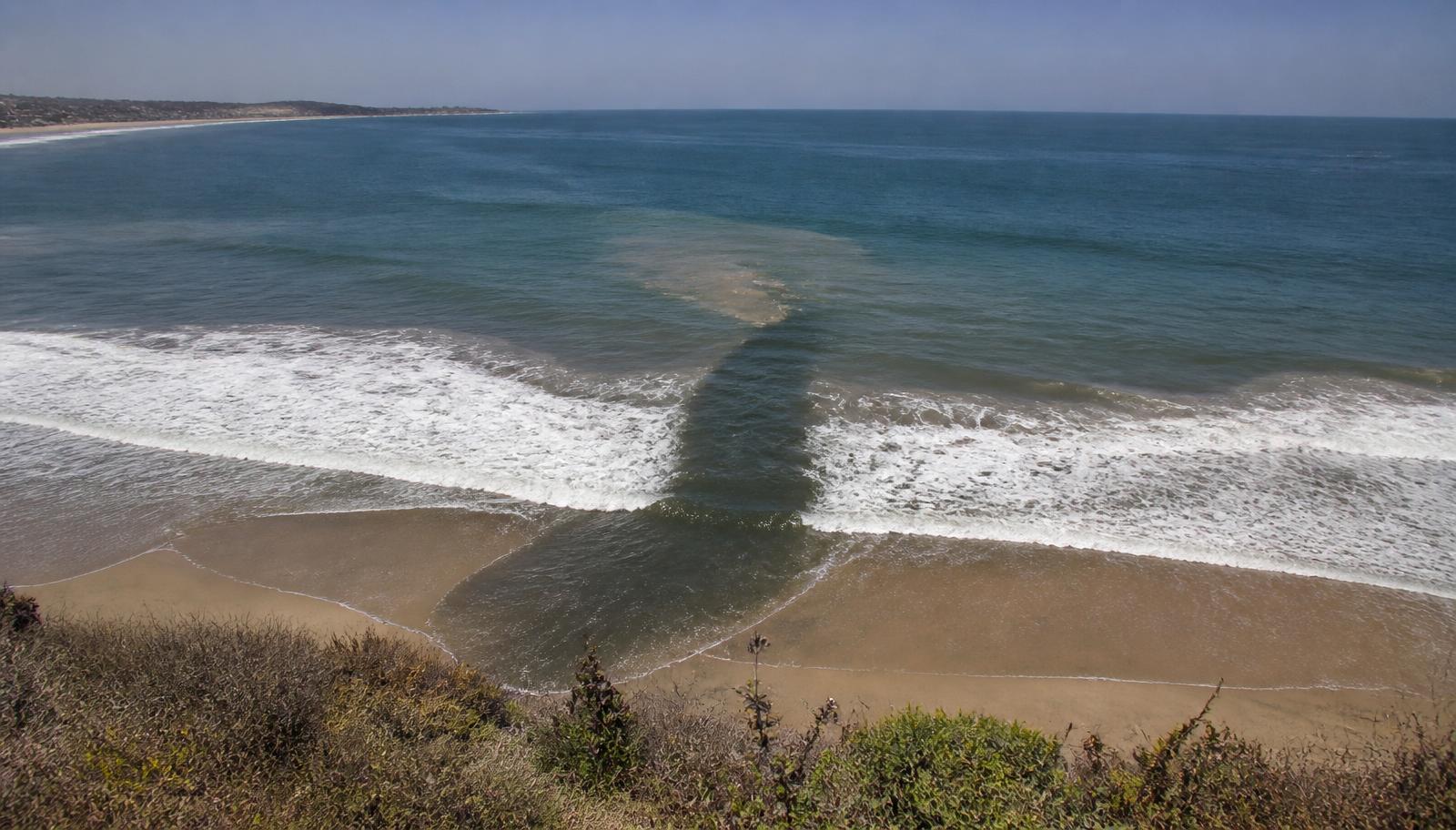
Scan the line where waves are turning white. If waves are breaking steadily to the left and steadily to the right, but there is a section in the middle where they don't break — or break much later and weaker — that gap is your first suspect. Outflowing water deepens the channel underneath, and deeper water means waves stand up further out or not at all.
A wave line with a hole in it is the single most reliable tell on a California beach.
2. A darker line of water heading out
From above, the rip channel often reads as a distinct darker stripe running perpendicular to the beach, cutting straight through the lighter, sandy-bottomed water on either side. Darker means deeper. Deeper means that is where the water is leaving.
Polarized sunglasses make this dramatically easier to see. It is a small thing that changes what you can read entirely.
3. Churned, sandy, discolored water
The opposite signature also works. Where the outflow is dragging sand off the bottom, you get a brown or tan plume pushing seaward past the surf line, fanning out at its head like smoke from a chimney. If a mud-colored tongue of water is reaching out past the breakers, you are looking directly at the current that made it.
4. Foam, seaweed, and debris moving away from the beach
Pick a piece of floating kelp or a patch of foam and just watch it for twenty seconds. Everything in the surf zone should be working its way toward the sand. Anything traveling steadily offshore is riding something. This is also the trick that works when the light is flat and grey and the color tells fail you.
5. The calm patch that looks inviting
This is the one that gets people, and it deserves its own sentence: on a beach where waves are breaking, flat water is a warning, not an invitation. Parents wade their kids into the calm spot between the whitewater precisely because it looks gentle. It looks gentle because the water in it is leaving.
Interactive myth fact — view the live version on this page.
If it happens: what to do, in order
Assume it will happen to you at some point. Everyone who swims here long enough gets moved by water they didn't plan on. The outcome depends almost entirely on the first fifteen seconds.
- Float. Breathe. Roll onto your back if you need to, get your face out of the water, and take three slow breaths. Drowning follows exhaustion, and exhaustion follows panic. The current cannot hurt you while you are floating on it.
- Do not swim straight back at the beach. That is a race against a current that can move faster than you can sprint, and you will lose it while burning everything you have.
- Let it take you until it eases. It will. Past the breaking waves the flow spreads out and weakens, usually within a minute or two.
- Then swim parallel to the shore, along the beach, until you are back in the zone where waves are actually breaking. That is water heading in.
- Ride the whitewater in. Let the broken waves push you, angling toward the sand.
- If you cannot swim out of it, don't fight it. Float, wave one arm overhead, and yell. That is the recognized signal, and lifeguards here are watching for it.
And if you are the one on the sand watching someone else in trouble: do not swim out after them. A large share of surf-zone drownings are would-be rescuers. Alert the nearest tower, call 911, and throw or push anything that floats — a boogie board, a cooler lid, a surfboard.
Where this matters most in San Diego
Rips are beach-specific and day-specific, but the county has patterns worth knowing before you pick a spot.
| Beach | What creates the risk | Worth knowing |
|---|---|---|
| Ocean Beach | Persistent channels and the pier/jetty structure | Long-standing reputation for strong pull; stay near a staffed tower |
| Mission Beach & Pacific Beach | Sandbar gaps, plus the jetty at the south end | Water alongside any jetty moves fast — give the rocks a wide berth |
| Blacks Beach | Deep submarine canyon focuses swell; limited lifeguard coverage | Advanced water. Not a casual swim beach |
| Torrey Pines | Long open stretch, shifting bars, sparse towers off-season | Big beach, few eyes on it outside summer |
| Coronado | Wide beach with strong shorebreak and lateral flow on bigger days | Gentle-looking and genuinely powerful when swell is up |
| Imperial Beach | Pier pilings and channels near the structure | Also check water quality before swimming here |
The single most useful decision you can make is not which beach — it is swimming near a staffed lifeguard tower. Rescue statistics are overwhelming on this point. San Diego's permanent towers run year-round at the main beaches, with seasonal towers added in summer; outside of summer, whole stretches of sand have nobody watching them.
Timing: when the risk goes up
Rip currents are not random. A few conditions reliably strengthen them:
- Bigger or longer-period swell. More water pushed onto the beach means more water fighting to get back off it. Check the surf report before you go, not after you're wet.
- A falling tide. As the tide drops, sandbars sit higher relative to the water and outflow is squeezed into fewer, faster channels. Low and dropping is prime rip time on many local beaches. The tide chart tells you which part of the day you're walking into.
- After a new swell has been running a day or two. Fresh channels get carved and stay carved.
- Onshore wind and messy, disorganized surf, which also hides every visual tell described above.
Interactive next tide — view the live version on this page.
Beach flags and how to get help
Colored flags at the towers are the fastest read on the day's conditions. Broadly: green is calm, yellow means moderate hazard and caution, red means high hazard, and double red means the water is closed. A purple flag flags dangerous marine life. Black-and-white checkered flags mark zones set aside for surfing and boards — not for swimming.
None of that replaces asking. Walk up the tower stairs and ask the lifeguard where the rip is running today. They will tell you, precisely, and they will usually point at it. It is the best ten seconds you will spend at the beach.
In an emergency: call 911 and say you need lifeguards, or get to the closest tower. Do not wait to see whether the swimmer sorts it out.
Going in with kids
Kids get into trouble in water that looks harmless to an adult, and mostly not from rips — from shorebreak, the steep wave that unloads directly onto sand and knocks them off their feet at the ankle-deep mark.
A few habits that make the whole day easier:
- Set up your towels within sight of a staffed tower, and point out the tower to the kids as the meeting place if they get lost.
- Keep small children at the shallow shorebreak on a gentler beach — La Jolla Shores, Coronado, and the sheltered bay beaches are far calmer than the open-coast breaks.
- Boogie boards are floats, not safety devices. They drift, and a kid chasing one goes wherever it goes. Leashes help.
- One adult always has eyes on the water with no phone in hand. Rotate the job every fifteen minutes so it's genuinely being done.
The two-minute pre-swim checklist
Before anyone gets in:
- Is there a staffed tower in sight, and what color is the flag?
- Watch the wave line for 60 seconds — is there a gap where waves aren't breaking?
- Look for a darker channel or a sandy plume heading out.
- Track a piece of foam or kelp — which way is it traveling?
- Ask the lifeguard: where's the rip today?
- Know your exit: pick a landmark on the beach so you can tell if you're drifting.
- Never swim alone, and never rely on inflatable toys past knee depth.
Six of those cost you nothing and take two minutes. The seventh — asking — takes ten seconds and is the most reliable of all of them.
One last thing
The ocean here is not out to get anybody. It is doing arithmetic: water comes in, water must go out, and it will use the easiest available door. Once you can see where that door is, the whole beach reads differently. You stop looking at the water as scenery and start seeing a system with a direction to it.
That is the entire skill. Two minutes on the sand, five things to look for, and a willingness to walk fifty yards down the beach to a better spot.
Check today's surf and swell, the tide chart, and current conditions at your beach before you go.
Sources and further reading: NOAA / National Weather Service rip current safety, United States Lifesaving Association, and City of San Diego Lifeguard Services.
Frequently asked
- How do you spot a rip current from the beach?
- Look for a gap in the line of breaking waves, a darker channel of deeper water running straight out, a plume of sandy or churned water pushing past the surf line, and foam or seaweed traveling offshore. On an otherwise breaking beach, a calm flat patch is a warning sign rather than a safe spot.
- What should you do if you get caught in a rip current in San Diego?
- Float first and get your breathing under control. Do not try to swim straight back to the beach against the flow. Let the current carry you until it weakens past the breaking waves, then swim parallel to the shore until you are back where waves are breaking, and ride the whitewater in. If you cannot get out, float, raise one arm and shout for the lifeguards.
- Is there really such a thing as an undertow?
- No. There is no current that pulls a swimmer down and holds them under. Rip currents move horizontally, away from the beach, at the surface. The real danger is panic and exhaustion from fighting the flow, not being dragged beneath the water.
- Which San Diego beaches have the strongest rip currents?
- Rips shift with swell and sandbars, but Ocean Beach, the jetty edges at Mission and Pacific Beach, Blacks Beach, and open stretches of Torrey Pines are known for strong, persistent pull. Conditions change daily, so ask the lifeguard on duty where the rip is running before you swim.
- Does the tide affect rip currents?
- Yes. Rips generally strengthen on a falling and low tide, when sandbars sit higher relative to the water and the outflow is squeezed into fewer, faster channels. Bigger or longer-period swell also strengthens them, since more water is pushed onto the beach and has to escape.
- Are San Diego beaches lifeguarded year-round?
- Permanent towers at the main beaches are staffed year-round, with additional seasonal towers added during the summer. Outside of summer, long stretches of sand have no coverage at all, so swimming near a staffed tower is the single most effective safety choice you can make.
- What do the beach flag colors mean?
- Green indicates calm conditions, yellow means moderate hazard and caution, red means high hazard, and double red means the water is closed. Purple warns of dangerous marine life, and black-and-white checkered flags mark surfing or board zones where swimming is not allowed.
- Should I swim out to help someone caught in a rip current?
- No. Untrained rescuers make up a significant share of surf-zone drownings. Alert the nearest lifeguard tower, call 911, and throw or push something that floats such as a boogie board, surfboard, or cooler lid toward the swimmer.